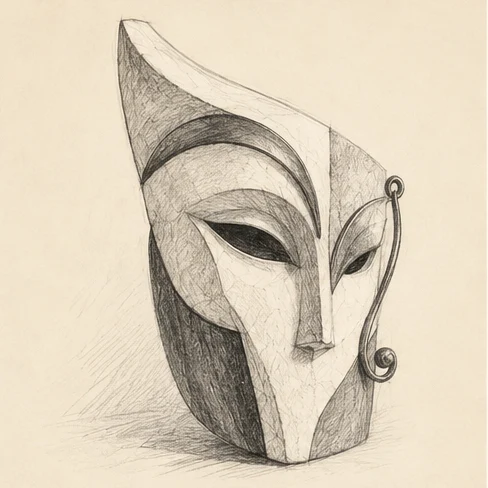
Before an audience sees the finish of a mask, it encounters a shape. A high brow extends the head upward; a projecting cheek breaks a smooth outline. Those choices can give a performer a distinct visual presence without a painted expression doing all the work.
Begin with the outside edge
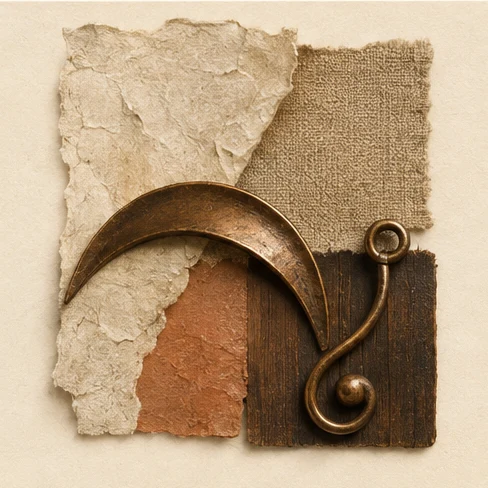
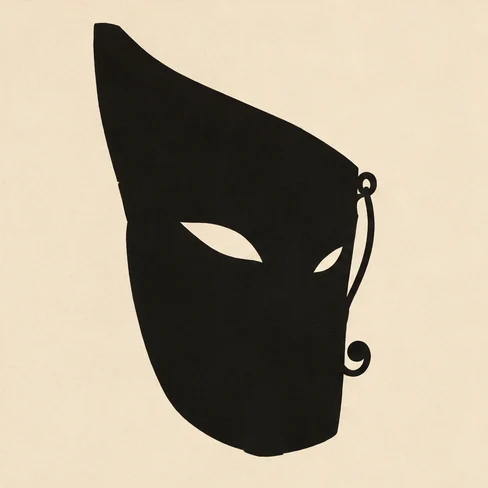
In our concept, one side of the brow rises higher than the other. That imbalance is a design decision, not evidence of a cultural origin. Cover the internal marks and the uneven contour remains. Now imagine the same head against a busy scenic backdrop: the small bronze details may disappear, while the brow still interrupts the background.
A useful drawing exercise is to make three versions of the same face: broad, tall and compressed. Fill each with a single dark tone. If the versions become indistinguishable when reduced, their differences depend on detail rather than silhouette. Neither approach is automatically better; the choice should follow the needs of the scene.
A face becomes a moving volume
A frontal drawing describes only one view. Turn the proposed mask toward a profile and check what happens to the nose, eye opening and lower edge. A cheek that looks modest from the front can become the strongest part of the outline from the side. A costume collar may conceal a carefully designed jaw.
Prepare a simple front, side and three-quarter study alongside the intended costume shape. Mark what is visible from each view. These drawings help identify questions for a later physical mock-up; they do not prove that the mask is comfortable, balanced or safe to wear.
Give the performer room to decide
The same fixed shape can be read differently when the head is lowered, held still or turned abruptly. Rather than naming a mask “angry” from its eyebrows, describe what is observable: the upper edge slopes inward, one cheek is longer, or the eye openings are narrow.
If a design goes into production, a performer and qualified maker should examine sightlines, breathing, fastening, weight and clearance. A compelling silhouette does not excuse an obstructed view. The digital concept shown here has not been fitted or rehearsed.
Keep the context attached
Documented performance traditions cannot be reduced to a collection of facial shapes. UNESCO’s account of Nôgaku, for example, places masks within a broader performance practice. That record provides context for a named tradition; it is not grounds for labelling an unrelated asymmetrical mask.
For our design, the accurate caption is straightforward: a contemporary digital concept exploring contrast between a tall brow and a compact lower face. Precise descriptions leave room for interpretation without inventing history.
Sources & scope
These references support the factual context. The exercises and concept-mask interpretations are original editorial proposals, not reports of practical testing.
- UNESCO Intangible Cultural HeritageNôgaku theatre
A named performance tradition with documented relationships between masks, performance and music. Not a visual identification key.
Text prepared with AI assistance. See authorship and human-review status. Source review and last update: 6 September 2026.